
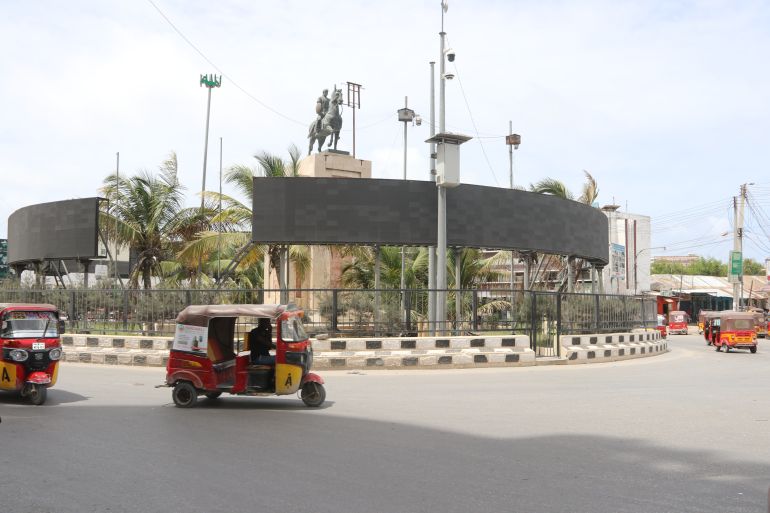




Somalia declares order restored after two days of fighting in Mogadishu
Violence that paralysed two Mogadishu districts subsides, but opposition rejects president’s rule and vows to fight on.
Save

 By Faisal AliPublished On 5 Jun 20265 Jun 2026
Mogadishu, Somalia – Fighting between government forces and opposition fighters that paralysed parts of Somalia’s capital, Mogadishu, for more than two days has eased, with the federal government declaring that it has restored order.
The violence erupted on Wednesday, and the government declared the districts of Abdiaziz and Hawlwadag calm on Friday.
Recommended Stories
list of 3 itemsend of list
“Opposition group militias have been disarmed and removed, and civilians have returned to their daily lives,” the Ministry of Information, Culture and Tourism said in a statement.
The violence stems from a dispute over whether President Hassan Sheikh Mohamud, the incumbent, will stay in power. He says parliament lawfully extended his term, while the opposition has called it a power grab.
It was the deadliest unrest in the capital in years, with each side blaming the other for the initial outbreak of fighting.
For almost two days, bursts of gunfire and loud explosions rang out across Mogadishu. Residential buildings near the fighting were hit in the exchanges.
The United Nations refugee agency said at least 13 people were killed and 189 wounded, and that some 12,500 households fled as the fighting spread through crowded districts, with some civilians trapped at home.
While the government says people have returned to normal life, UN officials warned that the humanitarian impact remains severe.
The fighting started near the home of former Prime Minister Hassan Ali Khaire in central Mogadishu, and then spread later to the residence of Sheikh Sharif Sheikh Ahmed, a former president, in the north.
Advertisement
Both have been spearheading an opposition push for demonstrations and timely elections.
A protest scheduled for Thursday became a flashpoint when Khaire and Sharif insisted on the right to hold protests at locations of their choosing with their own security teams overseeing them. It eventually did not go ahead due to the fighting.
The government rejected the proposal outright and warned against the march, arguing that security in the capital was fragile and that the action would further undermine it.
Clashes had broken out on Wednesday during a standoff between rival forces.
Khaire reached an agreement with the government on Thursday and was escorted by government security forces back to his other home in the secure airport compound.
Sharif held out for an additional day in his private residence in the northern Abdiaziz district, where the fighting was concentrated, until mediation by clan elders brought about an agreement to stop the fighting.
After the government said the districts were cleared, Sharif’s convoy returned to the fortified zone near the airport.
‘We aren’t scared and we won’t stop’
After Khaire emerged from his residence on Thursday, he was defiant at a news conference alongside other prominent opposition figures, saying the incident would not deter him.
“We won’t stop seeking the right for an election to take place in the country, and for it to happen as soon as possible,” he told reporters. “We won’t compromise on our continuing struggle. We won’t leave it, we aren’t scared, and we won’t stop.”
The unrest carried a heavy economic price.
Bakara market, the country’s largest, shut down, and Maka al-Mukarama Road, a main thoroughfare in the capital, was sealed off.
The central bank’s deputy governor put the losses to businesses and services at about $3.8m, while cautioning that this was a projection rather than a final figure.
The crisis is the latest turn in a long fight about how Somalia should be governed.
The country has not held a direct national vote since the late 1960s; since the state was rebuilt in 2012 after its 1991 collapse, leaders have been chosen by clan elders and elites.
A similar standoff in 2021 with former President Mohamed Abdullahi Farmaajo also turned violent.