


Gaza flotilla organisers in South Africa warn against Israeli interception
February 5, 2026
Germany’s Merz warns of potential escalation as US, Iran prepare for talks
February 5, 2026US treasury secretary declines to rule out future Federal Reserve lawsuits
US treasury secretary declines to rule out future Federal Reserve lawsuits
Scott Bessent used a Senate appearance to defend President Donald Trump’s campaign to slash interest and raise tariffs.

 By Al Jazeera StaffPublished On 5 Feb 20265 Feb 2026
Save
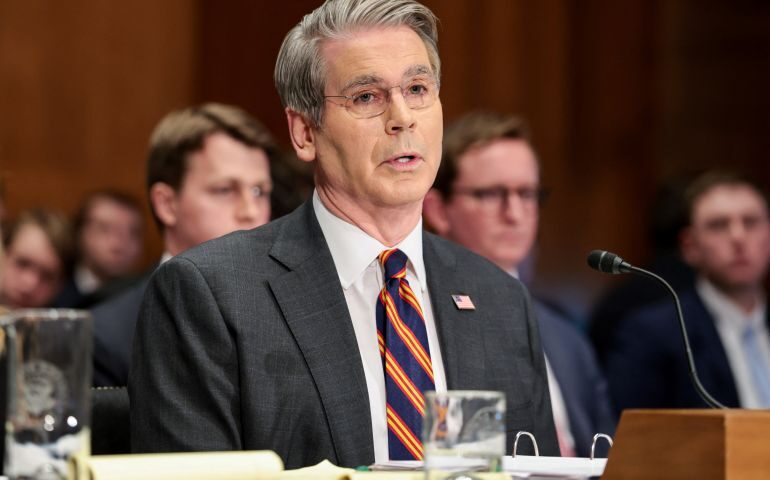
Treasury Secretary Scott Bessent has faced questions from the United States Senate about President Donald Trump’s ongoing campaign to slash interest rates, despite concerns that such a move could turbo-charge inflation.
Bessent appeared on Thursday before the Senate’s Financial Stability Oversight Council.
Recommended Stories
list of 3 itemsend of list
There, he received a grilling from Democrats over rising consumer prices and concerns about Trump’s attempts to influence the Federal Reserve, the US central bank.
One of his early clashes came with Senator Elizabeth Warren, who sought answers about a report in The Wall Street Journal that indicated Trump joked about suing his nominee for the Federal Reserve chair, Kevin Warsh, if he failed to comply with presidential demands.
“Mr Secretary, can you commit right here and now that Trump’s Fed nominee Kevin Warsh will not be sued, will not be investigated by the Department of Justice, if he doesn’t cut interest rates exactly the way that Donald Trump wants?” Warren asked.
Bessent evaded making such a commitment. “That is up to the president,” he replied.

Pressure on Federal Reserve members
Last week, Trump announced Warsh would be his pick to replace the current Federal Reserve chair, Jerome Powell, who has faced bitter criticism over his decision to lower interest rates gradually.
By contrast, Trump has repeatedly demanded that interest rates be chopped as low as possible, as soon as possible.
Advertisement
In December, for instance, he told The Wall Street Journal that he would like to see interest rates at “one percent and maybe lower than that”.
“We should have the lowest rate in the world,” he told the newspaper. Currently, the federal interest rate sits around 3.6 percent.
Experts say a sudden drop in that percentage could trigger a short-term market surge, as loans become cheaper and money floods the economy. But that excess cash could drive down the value of the dollar, leading to higher prices in the long term.
Traditionally, the Federal Reserve has served as an independent government agency, on the premise that monetary decisions for the country should be made without political interference or favour.
But Trump, a Republican, has sought to bring the Federal Reserve under his control, and his critics have accused him of using the threat of legal action to pressure Federal Reserve members to comply with his demands.
In August, for instance, he attempted to fire Federal Reserve Governor Lisa Cook based on allegations of mortgage fraud, which she has denied.
Cook had been appointed to the central bank by Trump’s predecessor and rival, Democrat Joe Biden, and she has accused Trump of seeking her dismissal on political grounds. The Supreme Court is currently hearing the case.
Then, in early January, the Department of Justice opened a criminal investigation into Powell, echoing accusations Trump made, alleging that Powell had mismanaged renovations to the Federal Reserve building.
Powell issued a rare statement in response, accusing Trump of seeking to bully Federal Reserve leaders into compliance with his interest rate policy.
“The threat of criminal charges is a consequence of the Federal Reserve setting interest rates based on our best assessment of what will serve the public, rather than following the preferences of the President,” Powell wrote.

Bipartisan scrutiny of Powell probe
Given the string of aggressive actions against Powell and Cook, Trump’s joke about suing Warsh fuelled rumours that the Federal Reserve’s independence could be in peril.
Within hours of making the joke on January 31, Trump himself faced questions about how serious he might have been.
“It’s a roast. It’s a comedy thing,” Trump said of his remarks as he spoke to reporters on Air Force One. “It was all comedy.”
Warren, however, pressed Bessent about Trump’s remarks and chided the Treasury chief for not rejecting them.
Advertisement
“I don’t think the American people are laughing,” Warren told Bessent. “They’re the ones who were struggling with the affordability.”
The prospect of Trump exerting undue influence over the Federal Reserve even earned a measure of bipartisan criticism during Thursday’s council meeting.
Senator Thom Tillis, a Republican from North Carolina, opened his remarks to Bessent with a statement denouncing the probe into Powell, even though he acknowledged he was “disappointed” with the current Fed chair.
Still, Tillis emphasised his belief that Powell committed no crime, and that the investigation would discourage transparency at future Senate hearings.
He imagined future government hearings becoming impeded by legal formalities, for fear of undue prosecution.
“They’re going to be flanked with attorneys, and anytime that they think that they’re in the middle of a perjury trap, they’re probably just going to say, ‘I’ll submit it to the record after consultation with my attorneys,’” Tillis said, sketching out the scenario.
“Is that really the way we want oversight to go in the future?”
For his part, Bessent indicated that he backed the Federal Reserve’s long-term goal to keep interest rates at about 2 percent.
“It is undesirable to completely eliminate inflation,” Bessent said. “What is desirable is to get back to the Fed’s 2 percent target, and for the past three months, we’ve been at 2.1 percent.”

Scrutinising the lawsuit against the IRS
As Thursday’s hearing continued, Bessent was forced to defend the Trump administration on several fronts, ranging from its sweeping tariff policy to its struggle to lower consumer prices.
But another element of Trump’s agenda took centre stage when Democrat Ruben Gallego of Arizona had his turn at the microphone.
Gallego sought to shine a light on the revelation in January that Trump had filed a lawsuit against the Internal Revenue Service (IRS) — part of his own executive branch.
Trump is seeking $10bn in damages for the leak of his tax returns during his first term as president. The IRS itself was not the source of the leak, but rather a former government contractor named Charles Littlejohn, who was sentenced to five years in prison.
Bessent was not named as a defendant in the lawsuit, though he currently serves both as the Treasury secretary and the acting commissioner of the Internal Revenue Service.
Critics have argued that Trump’s lawsuit amounts to self-dealing: He holds significant sway over the Justice Department, which would defend the federal government against such lawsuits, and he could therefore green-light his own settlement package.
In Thursday’s exchange with Gallego, Bessent acknowledged that any damages paid to Trump would come from taxpayer funds.
“ Where would that $10bn come from?” Gallego asked.
“ It would come from Treasury,” Bessent replied. He then underscored that Trump has indicated any money would go to charity and that the Treasury itself would not make the decision to award damages.
Advertisement
Still, Gallego pressed Bessent, pointing out that the Treasury would ultimately have to disburse the funds — and that Bessent would be in charge of that decision.
That circumstance, Gallego argued, creates a conflict of interest, since Bessent is Trump’s political appointee and can be fired by the president.
“Have you recused yourself from any decisions about paying the president on these claims?” Gallego asked.
Bessent sidestepped the question, answering instead, “I will follow the law.”